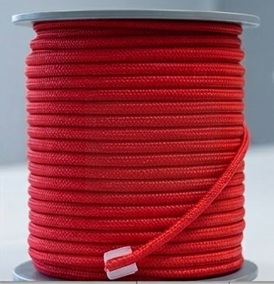
The U.S. military standard MIL-C-17183 governs the manufacture of high-tenacity nylon (polyamide) cords and braids characterized by a hollow orcoreless structure. Specifically designed for aerospace, defense, and technical skydiving applications, MIL-C-17183 cord takes the form of a flat tubular sheath when not under tension.
This unique geometry gives it extreme flexibility, excellent suitability for industrial sewing, and the unique ability to be easily spliced (by folding the rope back on itself) to create absolutely secure lashing loops, without any knots.
Technical Specifications and Properties of MIL-C-17183
Hollow Tubular Structure (Coreless): The complete absence of internal strands (core) allows the braid to lie flat. This facilitates its integration into wing seams or the routing of internal guide wires.
Maximum Suppleness and Flexibility: Military-grade polyamide offers an excellent balance between tensile strength and suppleness, eliminating any risk of mechanical stiffness caused by cold temperatures at high altitudes.
Resistance to Harsh Conditions: Treated to resist friction abrasion, ultraviolet rays (UV-resistant), and exposure to aviation fluids (fuels, lubricants).
Ideal for Splicing: Its design allows for ultra-clean and aerodynamic terminations via simple over-lapping or locked splicing.
Operational Application Areas
Manufacture and repair of parachutes (connection straps, pod locking lines).
Flexible protective sleeves for small technical lines or thin cable bundles.
Lightweight extraction systems and deployment lines for military aviation.
Safety and survival equipment for flight crews.
Technical Comparison: MIL-C-17183 vs. Key Defense Standards
MIL-C-17183 vs MIL-C-5040: Core-less Construction vs Kernmantle Construction
This is the most significant technical distinction in your catalog. While the well-known MIL-C-5040 features a “Kernmantle” construction (an outer sheath protecting a central core composed of several twisted strands), the MIL-C-17183 specification is entirely hollow. The MIL-C-5040 is ideal for survival and general rigging thanks to the versatility of its detachable strands, while the MIL-C-17183 is preferred in pure aeronautics for its ability to be spliced flat and sewn directly onto wing fabrics without creating rigid bulk.
MIL-C-17183 vs MIL-C-7515: Aviation Precision vs Heavy Cargo Drop
Although these two braids are both made of high-tenacity nylon, their mechanical properties are designed to meet opposite requirements. MIL-C-17183 is a lightweight, flexible precision cord optimized for small components and the rigging of individual parachute canopies. In contrast, the MIL-C-7515 (Block Braided) standard defines heavy-duty, dense cords designed to withstand extreme kinetic shocks during the deployment of cargo parachutes or for the extraction of heavy cargo from the cargo holds of transport aircraft.
Regulatory Quality and Defense Procurement
So-called "tubular" civilian products do not meet military certification requirements. Choosing a MIL-C-17183-certified rope guarantees a perfectly consistent braid pitch, compliance with nominal breaking loads, and the absence of structural defects that could compromise flight safety.
Logistics and Certification: Our MIL-C-17183 ropes are available in standard colors (Natural White, Olive Drab, Black) and are always accompanied by their Certificate of Conformity (CC). They are configured to meet the criteria for assigning NATO Stock Numbers (NNO / NSN), which are essential for the defense supply chain.