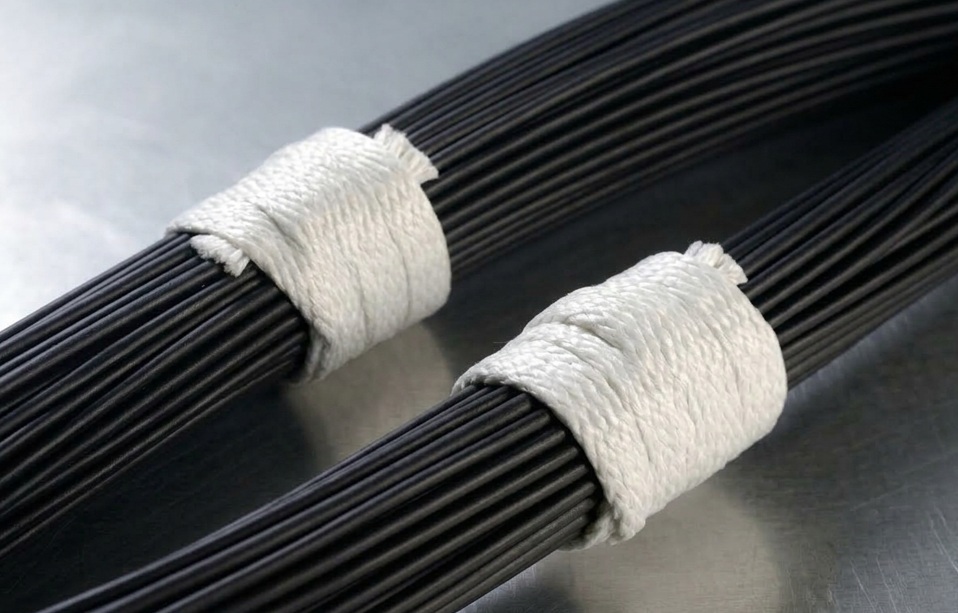
The US military specification MIL-T-43435, now widely associated with CID references A-A-52080 through A-A-52084, covers flat braided lacing tapes used to bundle and secure electrical cable harnesses in aerospace, space and defence applications.
Unlike rigid plastic cable ties, flat lacing tape distributes tightening pressure over a wider contact area while adding very little bulk or weight.
Material families
MIL-T-43435 is available in several material types selected according to the operating environment: Type I – Nylon / polyamide: General-purpose lacing tape. Associated with A-A-52080. Type II – Polyester: Selected where improved dimensional stability and temperature performance are required. Associated with A-A-52081. Type III – PTFE: Intended for chemically demanding or higher-temperature areas. Associated with A-A-52082. Type IV – Glass fibre: Intended for very high-temperature environments. Associated with A-A-52083. Type V – Nomex / aramid: Selected for fire- and cut-resistant cable-management applications. Associated with A-A-52084.
Finishes can vary according to the specification and may be selected to improve knot holding or reduce fraying.
MIL-T-713 covers round lacing cord or twine, while MIL-T-43435 uses a flat braided tape. The wider bearing surface of flat tape is useful when cable insulation must be protected from concentrated tightening pressure.
MIL-T-5038 covers lightweight textile tape/webbing used for edging or reinforcement, whereas MIL-T-43435 is specifically intended for cable-harness lacing.
Size and breaking-load classes
The specification includes several standard sizes with different widths and minimum breaking-load requirements, allowing the tape to be selected according to the cable-bundle geometry and required retention force.